 - Gray.jpg)
.jpg)
.jpg)
.jpg)
.jpg)
.jpg)
.jpg)
.jpg)
.jpg)
.jpg)
.jpg)
December 2016, Germany

 It was the first time I was seeing the picture of an old man who was struggling to shoulder a heavy load. It was the picture of a Kurdish man: Khezr. The cyberspace was inundated with his pictures on that day.
His face was swollen as a result of a gum infection. While heaving the load on his shoulder, he was telling the camera that he was 70 years old and had no choice but to shoulder the load in order to feed his wife and children.
It was the first time I was seeing the picture of an old man who was struggling to shoulder a heavy load. It was the picture of a Kurdish man: Khezr. The cyberspace was inundated with his pictures on that day.
His face was swollen as a result of a gum infection. While heaving the load on his shoulder, he was telling the camera that he was 70 years old and had no choice but to shoulder the load in order to feed his wife and children.
Khezr was not alone. He was surrounded by old and young men, all alike. Their similarity was in the force of their lives; unemployment, force of their destiny. They were looking for employment and there was none. To keep their wives and children away from hunger, they took up a gruelling job. They shouldered heavy loads, panting, sweating along the mountain paths of Iraq and Iran. They scaled mountain after mountain. Every day was a new suffering and every moment a danger was in ambush for their lives.
Khezr’s suffering was heaving on my soul and mind. Finally, I went to Iran two months later.
3 March 2017, Iran-Iraq border zero point
“Every time that we come to the border to smuggle goods, we sell our lives to earn bread for the following day.” This was the 17-year-old Bahman. I had seen him one winter afternoon when he was scaling a mountain on a mule; in the long line of mule riders along the mountainous bends, which resembled a coiling snake, the beginning and end of which was hiding in fog.
He said: they call us smugglers! They say, what we are doing is wrong. Well, we know it. We have to do it, when we have no work in this cold hell. He said: the sufferings are not few. It is a bigger pain to be shot at by border guards; that is by far more tragic than shouldering loads in snow and storm. You are trying to earn bread for your wife and children, but they shoot at you from four directions, for the crime of shouldering loads, calling it smuggling.



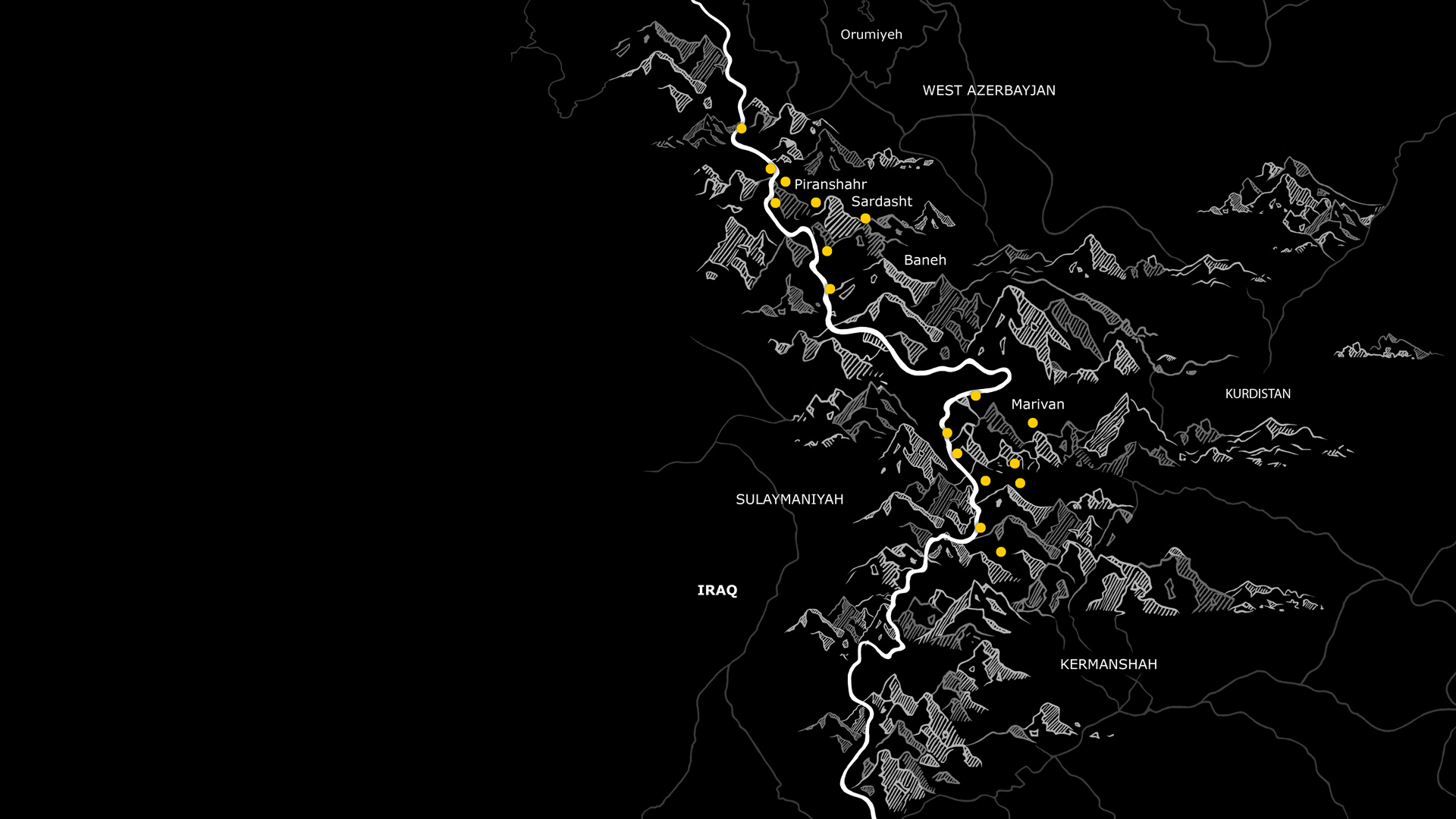
Iran has its longest border with Iraq: 1,458 kilometres. West Azerbaijan, Kurdistan and Kermanshah are Kurdish-populated provinces of Iran, were the people are Sunnis. More than 40,000 people in the cities and villages of these areas earn the bread of their families by smuggling goods (housewares, fabric, cigarettes, alcoholic drinks etc.). Families in these areas generally are large. This means that around 400,000 people are dependent on smuggling. Many other people earn their living by selling those goods in border markets or by brokering and shipping those goods to central cities of the country. I took pictures in those areas during seven trips over land in 2017 and 2018 in more than 20 days.
.jpg)
There are skilled guides among the Kulbars who are tasked to check the safety of the road with hunting binoculars and to report the conditions over the wireless telephone.
Duleh-Bid Village, city of Sardasht, 7 March 2017
“We do not deserve this. We defended these borders for eight long years during the Iran-Iraq war. We gave blood. Now, our children have to carry loads on their backs like animals for a bite and finally lose their lives on the job. They hunt us like animals.”
- Dervish Mohammad, city of Sardasht
.jpg)
.jpg)
.jpg)
With the evening approaching, groups of Kulbars arrive from the nearby villages and cities at the mountains and cross the border as a caravan. They include 13-14 years old children and 70-80 years old men. There are quite a few university graduates who have lost hope of finding employment.
Buaran Village, border area, 5 March 2017
“The proletariat hasnothing to lose butits chains.”
- Karl Marx
Kulbar: “shoulder carrier”.
Indeed, it is simple so long as it is not your profession. For them, however, it was their profession. It was their profession and the profession was apparent in their visages. Kulbar was no longer a simple word.
It was intertwined with the names of men who were trees and had their roots in the ground. It was as though history was taking shape in a different form in this part of the world. The “now” was intertwined with the “past”. There was the fatigue of the body and the smell of gunpowder.
They carried a load from one side to the other time and again. The soil was not waiting to be ploughed. It had already been ploughed under their feet. The pained faces of these men had depressed the soil. It didn’t have the energy to take the seed.
It was past sunset and the entire mountain was pitch-black. I was frightened. I had no energy. My clothes were totally wet from the rain at sunset and I was somehow freezing. We had set off with smugglers towards
the border in the afternoon. We were due to go to Iraq over the border mountains and come back with them. They would not accept to take me with them. They refused first and then gave it in when I persevered. This didn’t mean that they would
do anything for me or provide me with a mule. I had to go with them on foot.
Everything changed when darkness fell. When we reached the border zero point, the sound of volleys broke the silence of the mountain. Nothing could be seen. Everybody had taken their lives in their hands and was fleeing. It was as though that voices were fleeing; sound of successive anxious breathing; sound of hooves of horses and mules skidding on frozen rocks. Fear of bullets and falling down poured fright into my body. Everybody left; I remained with silence and blackness.
It occurred to me to go back the way I had come. My hands and feet were frozen. I had no energy left. But I was resisting the cold. I wanted to reach the destination. I couldn’t move more than a few metres on those snow- and ice-covered rocks. I didn’t know the way. I lost my energy.
.jpg)
.jpg)
.jpg)
The mountain skirt is fully covered with snow and one cannot walk on it. The Kulbars slide down their loads on snow. Then they load it on their shoulder at the bottom and move ahead. Depending on the goods, their load weighs between 40 to 100 kilograms. Sometimes they cannot load it on their shoulders on their own.
Tateh Border Pass, 1 March 2018
Unemployment is the biggest problem of the border dwellers. The ruling ideological outlook considers the dwellers of these regions as “outsiders”, based on ethnic and religious affiliations. The government is also concerned that autonomous movements may ascend in the Kurdish populated areas at western and north-western borders.
As a result of specific policies, the cultural, political and in particular economic domains have remained undeveloped in these regions. Border dwellers consider themselves victims of a certain definition of citizen in official terms. Unlike the people in central regions, they bear the brunt of second-class citizenship. As a result, they give priority to escaping hunger and finding a job over compliance with law.
.jpg)
.jpg)
The water was calm and green. Green it was. The boat was heavy and half sunk in water. It cut through the water like a sharp blade and went forward. When we reached near the village, the water lost its shine.
As though the village was empty. It was asleep. We jumped out of the boat and tied it with a rope to the truck’s rack. Everything was calm and safe inside the boat. But it became unsafe as soon as we left it. All heads turned with anxiety. When we were finished with unloading, the work was over. My job was over.
“Stay the night with us. There are no transport means to the town at this hour.”
.jpg)
.jpg)
.jpg)
“I raised my head and saw the officer of the Border Regiment standing above me. There was a soldier with him. Without uttering a word, he shot at my left knee from a distance of two or three metres. I fell on the ground and said: why are you shooting? This time, he shot at my right leg and they then went away. They shot at me in 2017 and I couldn‘t walk for a year. I have had more than five operations on my leg and I still can’t walk. My right leg is shorter now. I have been living in my brother’s home for a year and my sister-in-law looks after me. He can’t afford to pay for my medications and treatment. He is also unemployed.” Farhad, Kulbar
Marivan, 28 February 2018
According to figures documented by human rights groups, more than 76 people were killed and 64 injured in Kurdish-populated areas in 2016. Targeted shooting by security forces, frostbite and avalanche, falling down from the mountain, and mine explosion along the route were reasons for death and injury of the Kurdish shoulder carriers.
.jpg)
Shafi, 27 years old, was targeted by the Border Regiment in February 2017, when he was crossing the border on a horse. The bullet hit his right breast and threw him from the horse on the rocks. He suffered a spinal cord lesion when the back of his head crashed on the rocks. He is now paralysed. His parents take him to a clinic for physiotherapy every day. Owing to their poor financial conditions, they transport Shafi on a door.
Sardasht, 6 March 2017
“Goods smuggling is very important. They say that $15 billion is the money in smuggling. That is the minimum they mention today. Up to 20 billion and 25 billion have been mentioned. That is a very big amount. This is a blow to the national economy. Smuggling must be prevented.
Make no mistake. By smuggling, I don’t mean the poor Kulbar who crosses the border and brings back something on his back to provide for his family.
That is nothing, it is not significant.
We say: combat the huge goods smuggling gangs. Tens and hundreds of containers of various smuggled goods enter the country.”
From two speeches of Ayatollah Khamenei, leader of the Islamic Republic of Iran, 2017-2018
Text and Photography : Mohammadreza Soltani
Coding : Mansour
English Translation : Khalil Rostamkhani
Graphic : Minoo Hassanzadeh
Persian Narration : Ali Jalali
Music : Arshan
Special Thanks to everyone who made this project possible, in particular : Farzaneh Jalali Zainab Tasbandi Osman Mozayan Varia Delangiz Peyman Hoshmandzadeh Mehdi Dadkhah Kaveh Rostamkhani Søren Pagter
Produced by Mohammadreza Soltani
© August 2018. ALL RIGHTS RESERVED